 View full image ↗
Four drawings arrived as a band
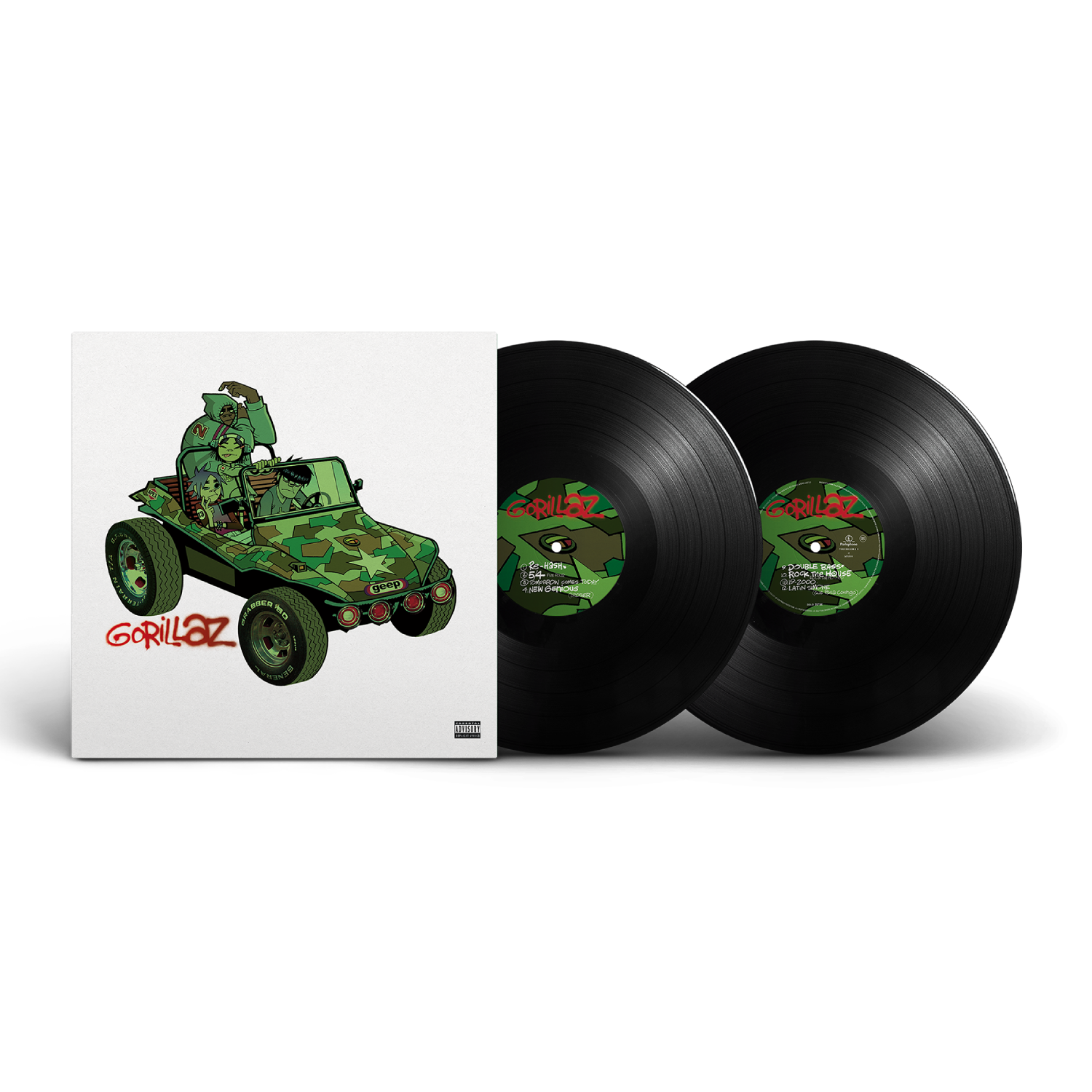
The official Gorillaz store dates the self-titled debut album to 26 March 2001 and names 2D, Murdoc Niccals, Russel Hobbs and Noodle as the group at the center of its world. It also credits Damon Albarn and Jamie Hewlett's combined work and identifies Hewlett's original artwork on the release. That retrospective source is promotional, but it fixes a useful milestone without requiring a made-up publication date: the album and its drawn cast were presented together.
The cover does more than provide a mascot. The four characters crowd into the same vehicle, each with a distinct silhouette and posture. Before a listener has learned any fictional biography, the image already communicates a scruffy group dynamic. Character design is doing the work a conventional band photograph might do while leaving room for impossible locations, elastic expressions and a story that can keep changing.
Consistency did not require stillness
A useful virtual identity needs anchors and permission to evolve. Gorillaz had both. Names, faces and recurring relationships made the members recognizable; different videos, drawings and later phases could alter styling without losing the act. The stable unit was not one perfectly preserved model sheet. It was the relationship among character roles, Hewlett's visual language and the music released under the group name.
That is a practical distinction for avatar performers. Locking every detail can make a character brittle, while changing everything between appearances makes recognition expensive. Define a small continuity kit instead: silhouette, two or three behavioral traits, a palette range, and the relationships that explain how the character occupies a group. Those are editorial suggestions derived from the case, not rules published by Gorillaz.
The humans stay in the credits
Calling Gorillaz a virtual band should not make Albarn, Hewlett, musicians, animators and production teams disappear. The official album description explicitly names its central creative collaboration, and the record itself carries performance and production credits. Fictional members organize the audience-facing world; they do not prove that authorship belongs to autonomous digital beings.
That boundary remains useful when reading newer acts. Avatar Dispatch's K/DA case follows characters that move among animation, game lore and a live stage, but named vocalists and production teams still make the performance possible. A responsible character project can invite the audience into fiction while keeping the labor record outside it accurate and accessible.
Design the handoff between formats
The Gorillaz identity can sit on a record sleeve, appear in a music video and support fictional documents because each format receives the part of the world it can carry. The album art establishes the ensemble at a glance. A video can add movement and comic timing. Liner material can name real contributors. Lore can reward attention without being required to hear the song.
For a small virtual act, the takeaway is mercifully achievable. Make a one-page map of what each format must communicate. A thumbnail needs a readable face or silhouette; a stream overlay needs room for motion and captions; credits need real names or agreed professional identities and clear roles; an archive needs dates that describe actual releases. The ambition is not to manufacture decades of lore on day one. It is to let sound and character reinforce each other while preserving a truthful account of who made the work.
Sources & limits
The official store retrospectively verifies the debut album's 26 March 2001 release date, the four fictional member names, and the Albarn-Hewlett creative framing. Analysis of silhouettes, continuity and cross-format handoffs is original editorial interpretation; no claim is made that the store page is a contemporary 2001 publication.
- Gorillaz (2LP Black)
first-party · Publication date not stated · Retrieved 19 September 2026 - Gorillaz 20th Anniversary Super Deluxe Vinyl Boxset
first-party · Publication date not stated · Retrieved 19 September 2026
Send a correction with the passage and supporting source.