What happened
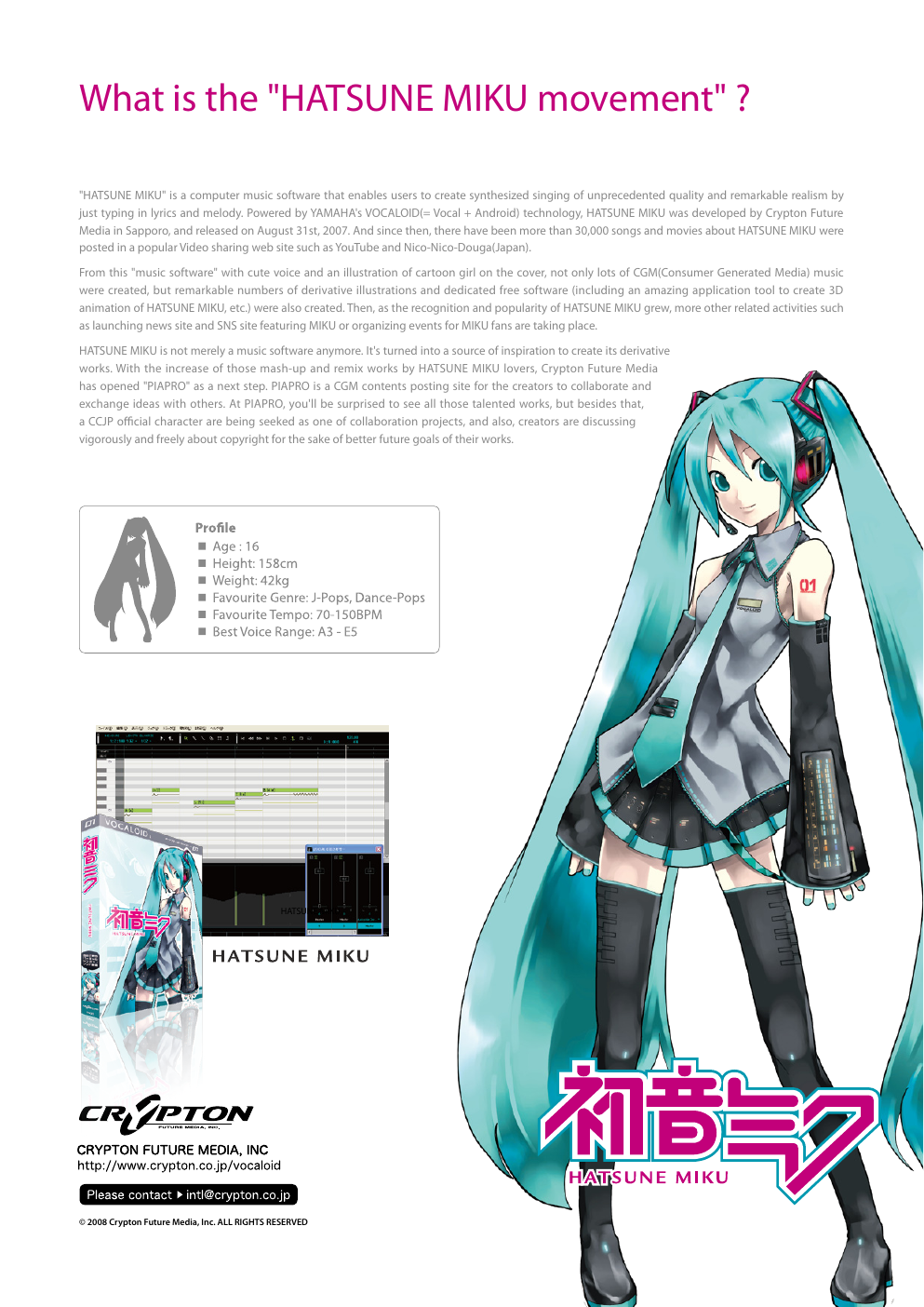
Crypton Future Media released Hatsune Miku on 31 August 2007 as software for generating a sung vocal from entered melody and lyrics. Its English product sheet describes a voice sampled from actor Saki Fujita and presents a defined character profile alongside the technical instrument. The original box therefore made the illustrated performer part of how the tool was understood, rather than leaving the synthetic voice as an anonymous preset.
That pairing created a productive ambiguity. Miku was a purchasable instrument, a recognizable fictional person and a surface for new songs and images. Crypton’s source stresses that users could produce vocal parts on a computer; it does not claim that every later interpretation was centrally directed. The important design move was to give distributed creative work a shared face.
The human implication
For creators, the character offered continuity without requiring a single human performer to appear each time. A song could carry an identifiable vocalist while its composition, illustration and video came from different people. Recognition accumulated around the character even as authorship remained distributed across individual works.
This model complicates the usual relationship between face, voice and owner. A stable avatar can help audiences find a creative scene, but it can also obscure the labor behind each appearance unless credits travel with the character. Miku’s launch suggests that an avatar platform needs two kinds of identity at once: a coherent public figure and legible attribution for the people who animate, tune, draw and stage it. The product record proves the starting mechanism. The broader culture belongs to many later works and should be documented through their own sources.
Sources & limits
Crypton establishes the product date, software function and creator-oriented character framing; it does not by itself measure Miku’s later cultural reach.
- HATSUNE MIKU Product Information
first-party · Publication date not stated · Retrieved 15 September 2026 - Hatsune Miku V2 product page
first-party · Publication date not stated · Retrieved 15 September 2026
Send a correction with the passage and supporting source.