Three ways to meet a partner
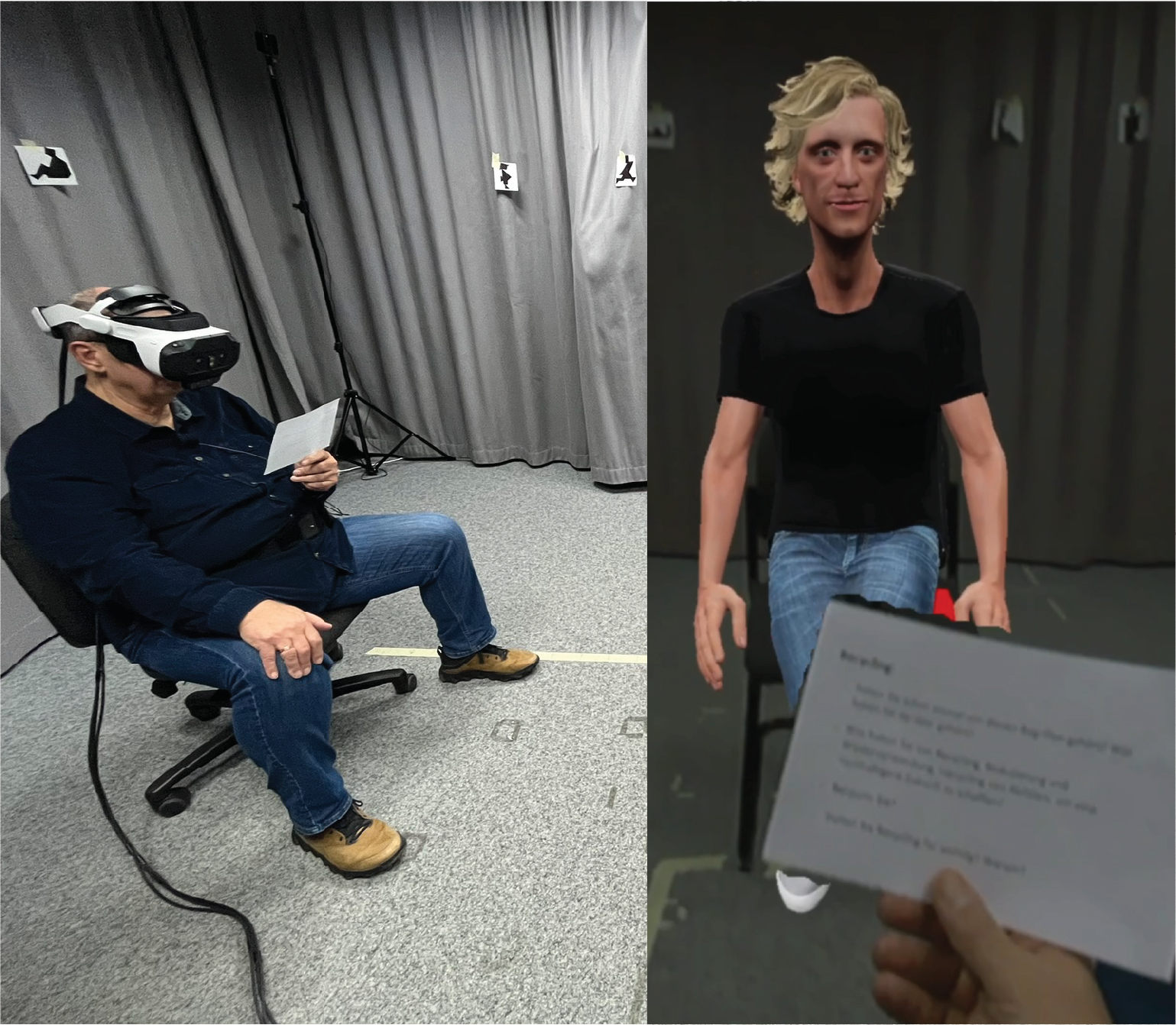
Stephanie Arevalo Arboleda and colleagues conducted an exploratory comparison with ten older adults. Participants encountered a human conversation partner face to face, through an augmented-reality avatar and through a telepresence robot, in conversation and spatial collaboration tasks. The paper describes appreciation for avatar expression and for the robot’s physical presence, alongside limitations in both. It does not establish that either alternative broadly outperforms face-to-face interaction or reduces loneliness.
Presence has several practical meanings
A face can communicate a reaction. A physical device can occupy a place in the room. A remote partner can also be present through a familiar voice, a shared task or an easy exchange of turns. These contributions should not be compressed into a single ladder from less real to more real. The useful choice depends on what people are trying to do together.
The spatial task is therefore worth noticing alongside the conversation. Pointing to something, moving around a room and understanding where a partner is looking create demands that a close-up talking-head demonstration may never test. A product review should describe those actions in ordinary terms. Can the partners refer to the same object? Can they recover when a gesture is missed? What has to be explained before the interaction becomes comfortable?
A promising encounter is a beginning
A ten-person exploratory study can expose preferences and difficulties that help shape the next design. It cannot support a broad claim about older people as one homogeneous audience. Nor should positive reactions to a short session become a claim of health benefit. The more informative story is the comparison itself: different bodies distribute expression, movement and physical presence differently. For anyone commissioning a remote social experience, the next step is to evaluate the actual activity with its intended users and to keep their preferences visible when selecting the interface.
Sources & limits
Exploratory ten-person study, not a clinical trial or proof of reduced loneliness. No general preference is assigned to all older adults.
- Exploring Mediated Communication with Older Adults: Comparing AR Avatars, Telepresence Robots, and Face-to-Face Interaction
original-research · June 2026 · Retrieved 15 September 2026
Send a correction with the passage and supporting source.