An income headline can change the way a person sees a hobby. It can make a commission feel recoverable, a longer schedule feel justified, or a job change seem closer. That makes the definition behind the number part of the story.
What the study actually observes
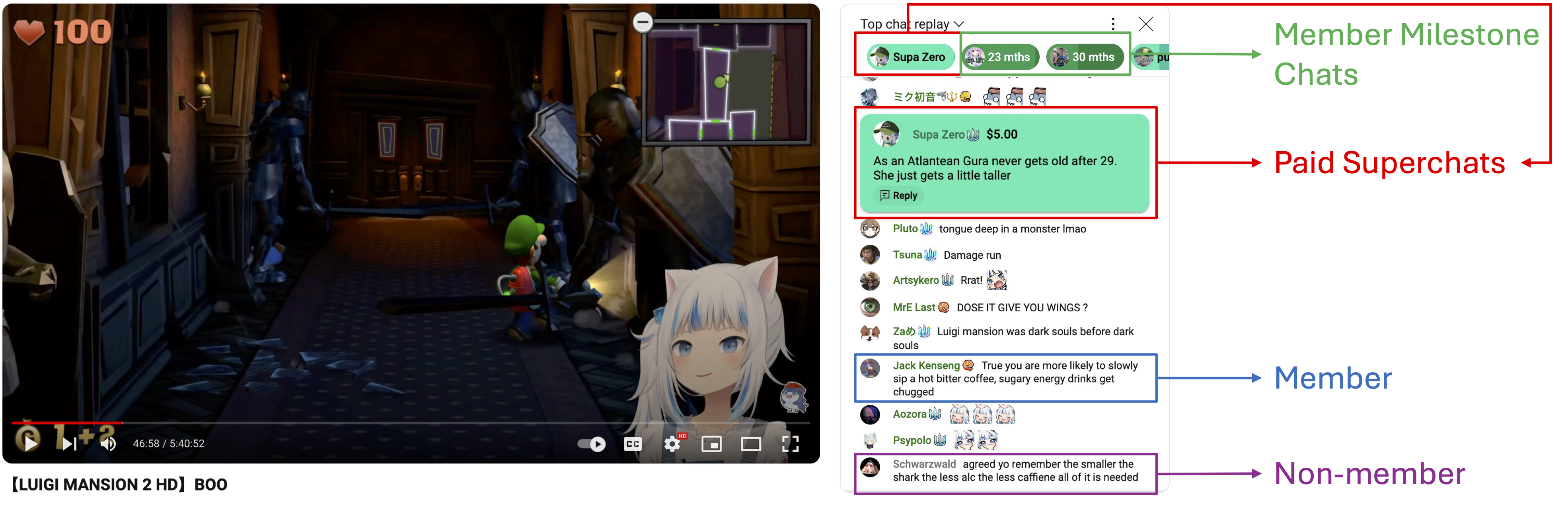
Who Reaps All the Superchats?, by Ruijing Zhao and colleagues, examines publicly available streaming records from 1,923 virtual YouTubers, covering more than a million hours. Its central finding is pronounced inequality in the observed income distribution, with agency concentration also part of the analysis.
The paper studies a particular platform and set of records. Its existence does not turn a revenue channel into a complete account of a working life. Sponsorships, merchandise, private agreements, and production costs are different pieces of evidence. A figure without those boundaries invites the reader to supply a story the dataset cannot tell.
Read the shape before the center
When a distribution is strongly uneven, a small set of large values can pull an arithmetic average far from the experience of many people in it. That is a property of the calculation, not a moral judgment about successful creators. Before repeating a headline average, ask how observations are spread and whose activity is missing.
A median answers a different question: where the middle observation falls after ordering the values. It still does not guarantee that the sample represents a newcomer, a different language community, or a different period. Replacing one summary number with another cannot repair a mismatch between the question and the data.
Reading rule: Keep the unit beside the number. Per channel, per month, and per observed stream describe different things.
The human implication
Creators do several kinds of work around a stream. Planning a segment, practicing a song, moderating a community, editing a clip, and arranging a collaboration can all happen outside the visible broadcast. A platform record is a view into that work, not a time sheet for the whole production.
This matters for how we cover success. A large channel can demonstrate that an audience exists without establishing how another creator can reach it. An agency total can describe an organization without telling us what an individual performer receives. Keep the organization, the character, and the person distinct when reading the evidence.
Questions to bring to the next chart
Look for the collection period, inclusion rules, revenue categories, and the way inactive or missing channels were handled. Ask whether the figure represents amounts paid by viewers, amounts received by a platform account, or money left after costs and sharing agreements. If the source cannot answer, carry the uncertainty forward.
Then ask whether the chart addresses the decision in front of you. A historical study may be valuable for understanding concentration while saying very little about the prospects of a specific show. A creator interview may explain a workflow while offering no basis for a market-wide estimate. Each source has a job.
Avatar Dispatch’s choice is to make those edges visible. We can describe the pressures around virtual performance without presenting a single number as the wage of becoming a character.
Sources & limits
The cited study concerns observed VTuber activity on YouTube. It does not describe every platform, every creator, current take-home earnings, or a forecast for a new channel. This article discusses how to read the evidence and deliberately does not supply an average-salary estimate.
- Who Reaps All the Superchats? A Large-Scale Analysis of Income Inequality in Virtual YouTuber Livestreaming
first-party · 2 March 2025 · Retrieved 15 September 2026
Send a correction with the passage and supporting source.