What the movement gave away
Your avatar's face is only one part of the data trail. Vivek Nair and colleagues studied head and hand motion from 55,541 Beat Saber users. With five minutes of training data per person, their system identified users within that known pool with reported accuracy of 94.33 percent from 100 seconds of movement and 73.2 percent from ten seconds. This is recognition against previously collected records. It does not mean a brief movement trace automatically reveals someone’s legal name or identifies a person absent from the training collection.
The face is only the visible layer
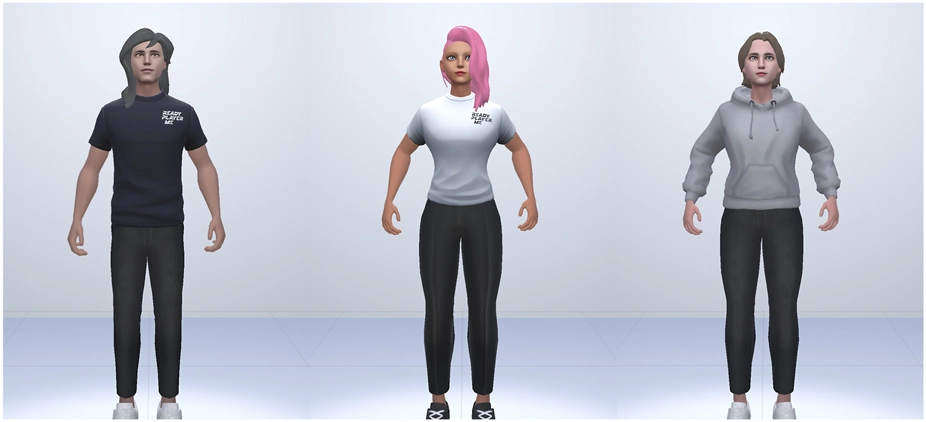
A performer can change hair, species and voice while preserving familiar physical habits. That continuity is often part of the pleasure of an avatar: friends recognize how someone dances or gestures. The paper asks what happens when a system studies that continuity at scale. Privacy choices made in a character editor may have little relationship to the records needed to animate the character in the first place.
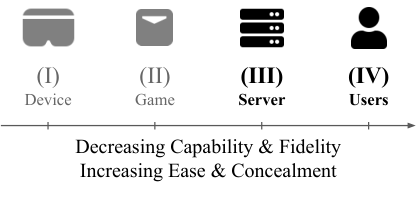
For platform reporting, a useful data diagram should follow the movement. Which component receives raw tracking? What is transmitted to other participants? Is it stored, transformed or discarded? The figure separates possible observers because they do not have identical access. A vague promise that an avatar is anonymous cannot answer those questions. Equally, this study should not be turned into a claim that every viewer has the demonstrated identification capability.
Follow the data past the character editor
The result makes data handling a central part of avatar coverage. A proposed privacy feature needs to explain what information it changes and which observer it is meant to limit. It also needs evaluation: adding noise that destroys a dancer’s movement may protect a trace while making the experience unusable. This reading does not prescribe a particular defense. It identifies a reporting obligation to distinguish a public persona, an account identifier and the behavioral records that could connect sessions. Changing the first does not necessarily change the others.
Sources & limits
Known-pool identification in a specific dataset and training setup. Accuracy is not proof of legal-name identification, universal tracking or access by ordinary viewers.
- Unique Identification of 50,000+ Virtual Reality Users from Head & Hand Motion Data
original-research · 17 February 2023 · Retrieved 15 September 2026
Send a correction with the passage and supporting source.