 View full image ↗
The hosted service had an end date
Mozilla Support says support for Mozilla Hubs ended on 31 May 2024. Afterward, people could no longer create accounts, use the demonstration server or create new Hubs Cloud instances through Mozilla's service. That is a concrete service ending, not merely a pause in feature development. URLs, account flows and hosted infrastructure that had made rooms easy to enter were part of the product.
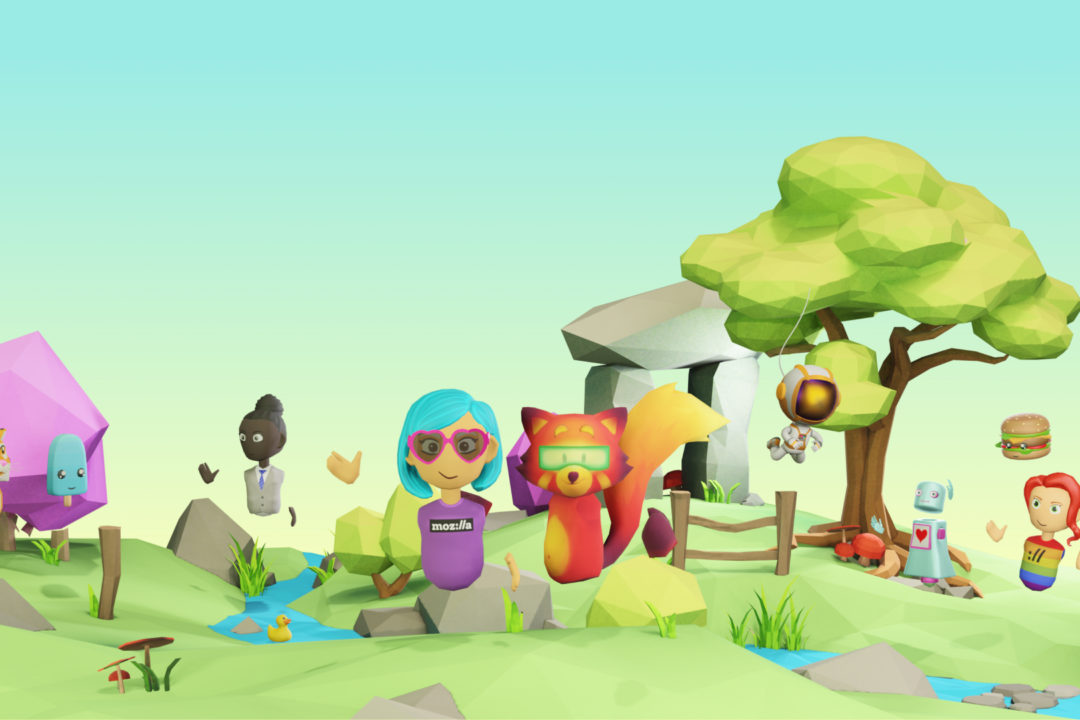
A 2022 Mozilla article captures what that convenience enabled before closure: people could enter 3D rooms from a browser, including on desktop or mobile, and hosts could control access. It presented Hubs as useful for galleries, classes and gatherings without requiring a specialized headset. The official image here comes from that earlier explanation and is labeled as 2022 context, not shutdown-day evidence.
The repository survived the service
Mozilla's shutdown page points readers to the Hubs Foundation, which now manages and maintains the codebase. Foundation documentation describes Community Edition as a self-hosted continuation of the Hubs experience, and its public repository identifies the client as open-source software for online 3D collaboration across desktop, mobile and VR. That is meaningful continuity: the interaction model can be studied, run and changed rather than sealed inside a discontinued binary.
It is not the same continuity as keeping a room online. Someone must provide hosting, configuration, updates, moderation and support. An open license answers whether the code may continue; it does not appoint an operator or restore a person's account.
A social place has more than one dependency
For comparison, Avatar Dispatch's account of VRChat's user-built bodies emphasizes a platform where identity and community depend on an ongoing service as well as creator files. Hubs makes the layers especially easy to name: client code, server deployment, room assets, identity, access policy and the human group that knows when to meet. Saving one layer does not automatically reconstruct the others.
This is why a source-code handoff can be both a success and an incomplete preservation plan. The code can preserve possibilities. A specific classroom, gallery opening or weekly meetup also needs its assets, documentation, schedule and participant contacts. Those are social records, not software features.
Build a continuity map before the notice arrives
A useful planning exercise is to draw six boxes for any hosted virtual venue: code, hosting, assets, accounts, moderation and community communications. Record who controls each box, what can be exported, and what replacement would be required. This is original editorial guidance, not a Mozilla migration guarantee. It also avoids the comforting but false shorthand that an open-source release preserves everything.
Mozilla Hubs provides a nuanced ending. The vendor-hosted path closed on a verified date, while an organized community retained a technical foundation for new deployments. Readers should hold both facts together. Software continuity can make reconstruction possible; careful operational preparation determines whether a particular social place and its regular participants actually make the crossing.
Sources & limits
Mozilla Support verifies the 31 May 2024 service end and names functions that became unavailable. Mozilla's 2022 article documents the earlier browser-room proposition, while Hubs Foundation documentation and its repository document Community Edition continuity. The six-layer continuity map is original editorial analysis.
- End of support for Mozilla Hubs
first-party-support · Publication date not stated · Retrieved 19 September 2026 - Mozilla Hubs is a platform for creating your own virtual spaces
first-party · 29 November 2022 · Retrieved 19 September 2026 - Hubs Foundation documentation
community-project-documentation · Publication date not stated · Retrieved 19 September 2026 - Hubs Foundation client repository
community-project-repository · Publication date not stated · Retrieved 19 September 2026
Send a correction with the passage and supporting source.