 View full image ↗
Studio makes; Hub presents
Pixiv launched VRoid Hub on 21 December 2018 as a platform for uploading and sharing humanoid 3D models. Its announcement said a submitted model could receive an animated browser profile, be distributed with creator-set usage conditions, or be called into connected VR, AR and 3D services. It named VRoid Studio as one way to make a model, but it also accepted VRM files from other modeling tools.
That split is easy to miss because the products share a name. Studio is an authoring workbench; Hub is a publishing, identity and permissions layer. The site's history of VRoid Studio 1.0 covers the making side. Hub begins where a creator has to decide what the finished model is called, how it moves in a preview, who may see it and what others may do with it.
A profile is an interpretation of a file
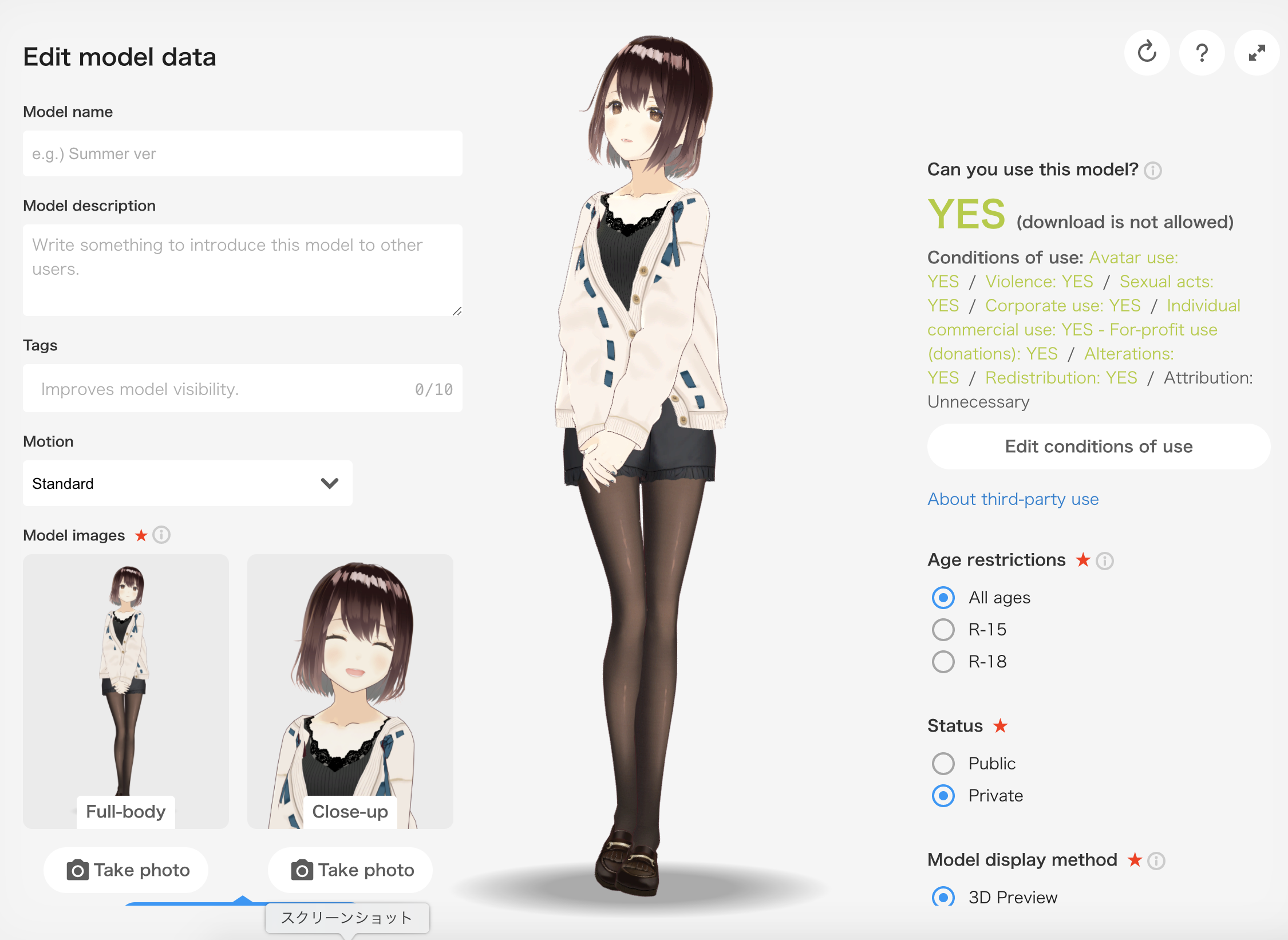
The launch post emphasized that a creator could upload a model and receive a profile page with animation, name, personality, setting and related links. Current help adds tags, chosen motions, a full-body image and a close-up. These fields do not alter the mesh, yet they strongly shape how somebody encounters the character. A neutral file becomes a public-facing identity through framing.
The later screenshot used here makes the handoff visible. Model description and images sit beside conditions of use, age restriction, public or private status, and the choice between a 3D preview and a still image. This is not the 2018 launch interface. It is useful contemporary documentation of how presentation and permission occupy the same publishing step.
Permission travels with the character
VRoid's help center explains that Hub can expose whether third parties may use a model, whether avatar use is allowed, and whether alteration, redistribution, commercial use or credit omission is permitted. It also says connected services should display and respect those conditions. When third-party use is allowed, Hub overwrites the VRM file's license fields and Other License URL with the conditions chosen on Hub; identity metadata including title, author, contact information, reference and version is retained. Publication therefore changes permission metadata while preserving those identifying fields.
That design reduces ambiguity but does not erase upstream licenses. A model can include textures or clothing made by somebody else. VRoid's examples warn that a derivative model cannot be redistributed if the source model forbids redistribution. The creator therefore needs to audit components before setting one inviting switch on the finished character.
Publish a permission card with the model
A practical workflow is to prepare a one-page permission card before upload. List the model author, component authors, allowed avatar use, alteration, redistribution, corporate and individual commercial use, required credit and a contact route. Then configure Hub to match the narrowest applicable permission. If the card and interface disagree, stop and resolve the conflict before making the model public.
This exercise is original editorial guidance, not legal advice. Its value is operational: the model page should not promise a freedom that an included outfit, texture or base mesh does not grant. VRoid Hub's cultural contribution is not only making characters visible in a browser. It makes the terms of that visibility part of the character's public presentation.
Sources & limits
Pixiv's dated launch announcement verifies VRoid Hub's 21 December 2018 availability, animated profiles, sharing and service integration. Living English help documents later settings and license behavior. The permission-card exercise is original editorial guidance, and the 2021 screenshot is not treated as launch imagery.
- 3D character model posting and sharing platform VRoid Hub launched
first-party-japanese · 21 December 2018 · Retrieved 19 September 2026 - What is VRoid Hub?
first-party-documentation · Publication date not stated · Retrieved 19 September 2026 - About VRoid Hub's conditions of use and VRM license
first-party-documentation · Publication date not stated · Retrieved 19 September 2026
Send a correction with the passage and supporting source.