A conversation across several weeks
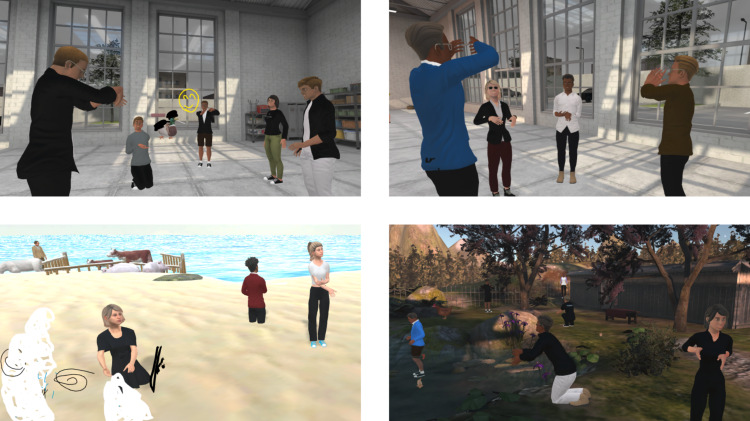
Mark Roman Miller and colleagues analyzed 232 participants across two studies involving eight weekly social VR sessions. Larger rooms were associated with greater interpersonal distance; distance and mutual orientation also changed over time. Groups and pairs showed persistent differences. The analysis uses head orientation as an indicator of gaze, rather than direct eye tracking. Its measurements therefore describe recorded spatial behavior, not certain knowledge of what each person was attending to.
World design quietly sets the stage
A creator can give every avatar a distinctive silhouette while placing the entire group in a room that discourages comfortable conversation. Scale, boundaries and the apparent center of a space influence where people gather. The paper makes those surroundings part of the social interface. It is a useful correction to coverage that treats the environment as decoration behind the characters.
Repeated sessions matter here. A first visit can involve exploration and learning how to move; a later meeting may reflect familiarity with the group or the space. A single screenshot cannot distinguish those stages. For event producers, this suggests looking at how a venue works across rehearsals and repeat visits, while asking participants what the observed arrangements mean to them. A ring of avatars could indicate inclusion, awkwardness or simply the location of a shared object.
Movement records need interpretation
The size of the dataset gives the researchers more behavior to examine, but it does not remove the need to explain the measures. Turning a head toward a partner is not identical to listening, and a larger gap is not automatically evidence of discomfort. Those distinctions protect the usefulness of the work. The study gives world builders a reason to examine rooms, groups and time together, then test concrete changes. It does not supply an automatic score for the quality of a community or a substitute for asking people about their experience.
Sources & limits
Repeated-session field research; head orientation is a proxy for gaze. Spatial records do not directly measure attention, belonging or conversation quality.
- A Large-Scale Study of Proxemics and Gaze in Groups
original-research · 2023 · Retrieved 15 September 2026 - Exhaustive Publication List — Virtual Human Interaction Lab
first-party · Publication date not stated · Retrieved 15 September 2026
Send a correction with the passage and supporting source.