 View full image ↗
A generic fallback solved the machine problem
A detailed PC avatar may exceed another device's performance rules, use unsupported components, or be blocked by a viewer's settings. VRChat's older fallback system could replace it with a separate, more efficient avatar selected by the wearer. That kept the room running, but VRChat acknowledged a social cost in its April 2023 preview: the fallback might look nothing like the intended character, leaving identity incoherent across devices.
This is the unglamorous edge of avatar portability. Two people can stand in the same virtual room and see different bodies for the same account. Performance policy becomes part of self-presentation whether or not the wearer designed it that way.
The body double keeps the outline
VRChat released Impostors with update 2023.4.2 on 30 November 2023. Its notes describe them as generated avatar body doubles used where a fallback or robot would otherwise appear. A PC-only avatar can therefore show a simplified but recognizable version to someone on another platform. Impostors can also appear when an avatar hits a performance block, and only owners can generate them for avatars they uploaded.
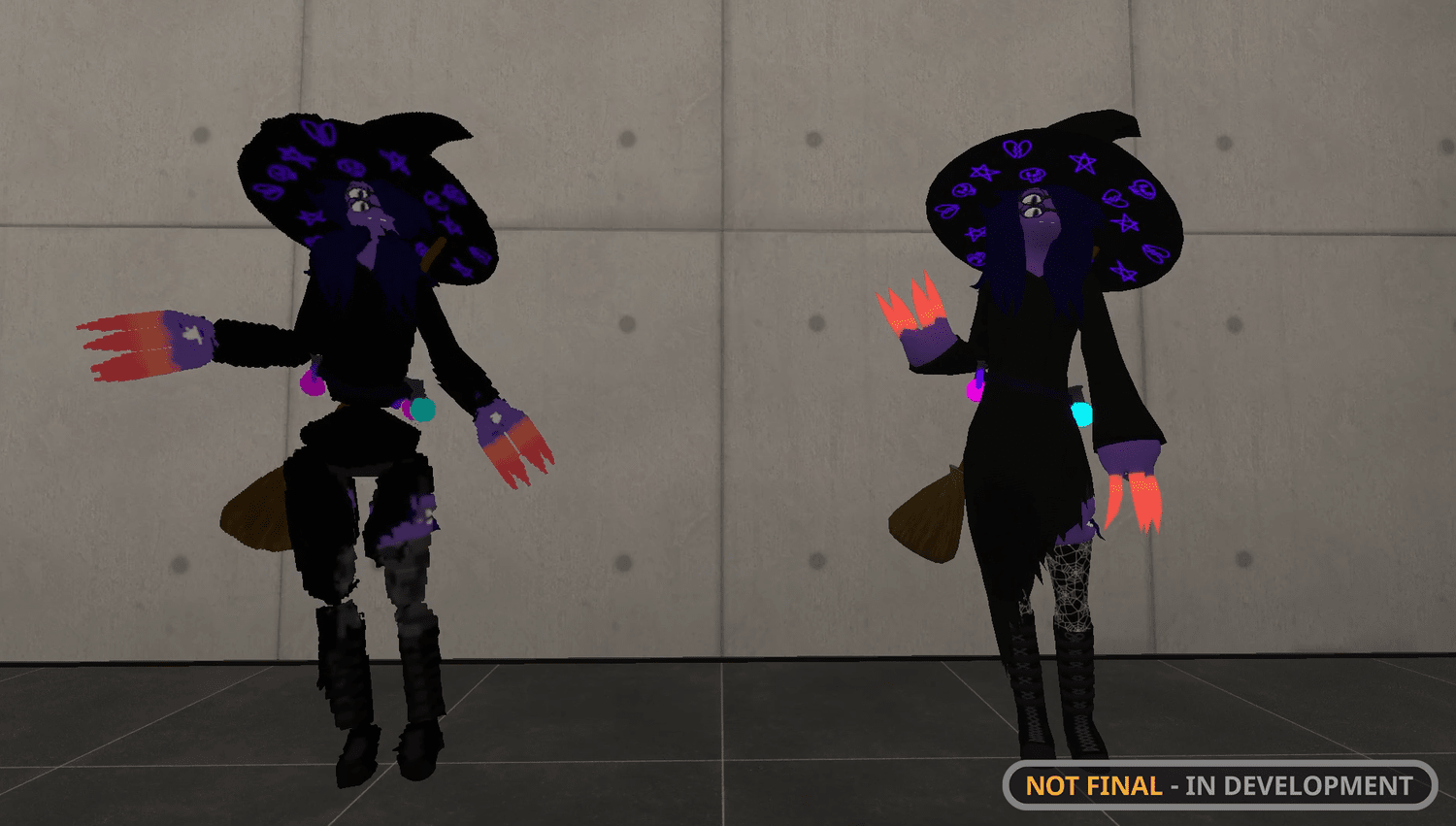
The official preview image is candid: the generated figure resembles the source but loses geometry and detail. It is stamped 'not final — in development.' That imperfection is the point. Graceful degradation does not preserve every shader or accessory. It tries to preserve enough silhouette, color and arrangement for a friend to know who entered the room.
Generated continuity has boundaries
At release, VRChat limited Impostors to humanoid avatars. The preview also warned that some outputs could look strange, break or fail to generate. The official wiki explains that an Impostor appears only when enabled and when the full avatar cannot be shown. A creator-built cross-platform version can still be the better choice when a character's identity depends on features the generator simplifies badly.
That gives creators three layers to plan: the full model, a deliberate lightweight version, and an automatically generated emergency representation. Name which traits must survive all three. A hat shape, tail color, face marking or high-contrast jacket may carry more recognition than a complex material effect that disappears on constrained hardware.
Preview identity from the weakest seat
A useful review is to compare the representations side by side, then ask somebody unfamiliar with the build to match them. This is a proposed editorial exercise, not a test Avatar Dispatch performed. Look for mistaken silhouette, unreadable face area, vanished mobility equipment, merged accessories and colors that collapse into one dark mass. Fix the source or provide a custom lightweight avatar when a central cue is lost.
The site's report on VRChat's mobile release shows the distribution end of the same problem: more device types mean more rendering boundaries. Impostors matter because they make those boundaries socially legible. The goal is not identical pixels everywhere. It is to avoid making a person's chosen identity disappear merely because somebody else entered through a different screen.
Sources & limits
VRChat's official release notes and wiki verify the 30 November 2023 release, ownership and humanoid limits. The April preview explains the fallback problem and supplies explicitly unfinished comparison imagery. The three-layer review is original editorial guidance, not a hands-on test.
- VRChat 2023.4.2
first-party-release-notes · 30 November 2023 · Retrieved 19 September 2026 - April Developer Update
first-party · 6 April 2023 · Retrieved 19 September 2026 - Impostors — VRChat Wiki
first-party-documentation · Publication date not stated · Retrieved 19 September 2026
Send a correction with the passage and supporting source.