The encounter was measured in movement
Jeremy Bailenson and colleagues examined personal space around a virtual human in experiments reported in December 2001. Participants moved through an immersive environment during a memory task. They maintained more distance from a virtual human than from a similarly shaped nonhuman object, and the experiments examined how gaze behavior changed responses. The study used restricted character materials and conditions; its reported differences between participant groups should not be treated as fixed rules about gender.
A social cue did not require a modern face
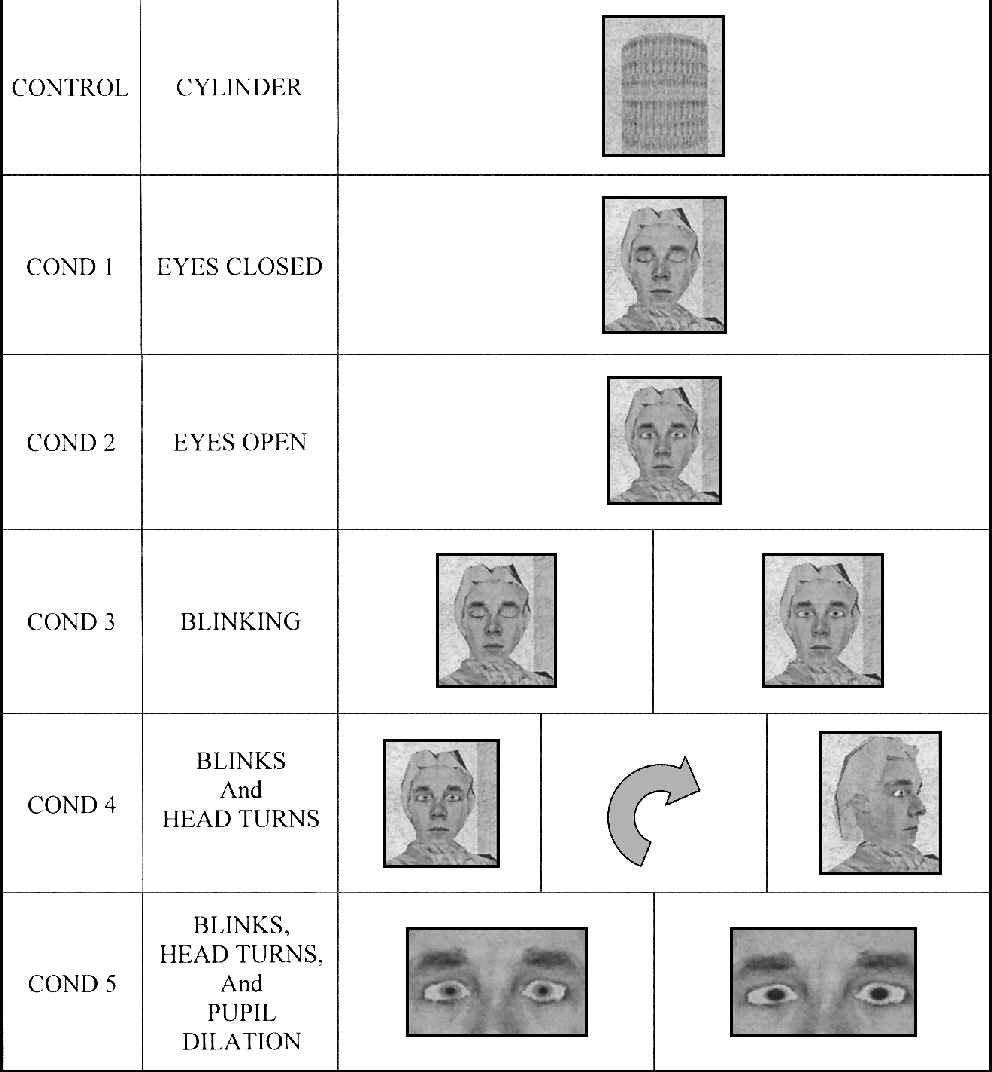
The preserved chart looks modest beside today’s finely shaded digital humans. That is part of its historical value. It shows researchers isolating eyes, blinking and head turns rather than waiting for a perfectly realistic person. The question was whether these cues affected how someone approached a figure. Visual fidelity and social consequence were already separate things to investigate.
For a creator looking backward, the chart offers a useful production exercise: list the behaviors that make a character seem to notice a visitor. A glance, pause or turn may do more work in a scene than another layer of surface detail. That observation is an editorial interpretation, not a performance guarantee extracted from the experiment. The effect of a cue still depends on the setting and on what the visitor expects.
Keep the old apparatus in the story
Historical research becomes misleading when its findings travel without its materials. The virtual human, control object, tracking setup and assigned task define what the experiment could establish. A modern social world contains voices, friends, norms and choices that this comparison did not reproduce. Reading the original figure alongside the result keeps that boundary visible. It also expands the history of avatars beyond a sequence of prettier models: long before current platforms, researchers were asking how a represented person changes the way another person uses a room.
Sources & limits
Historical controlled experiments using restricted avatars and tasks. No universal spacing or gender rule is inferred.
- Equilibrium Theory Revisited: Mutual Gaze and Personal Space in Virtual Environments
original-research · December 2001 · Retrieved 15 September 2026
Send a correction with the passage and supporting source.