Predicting a motion, not only an event
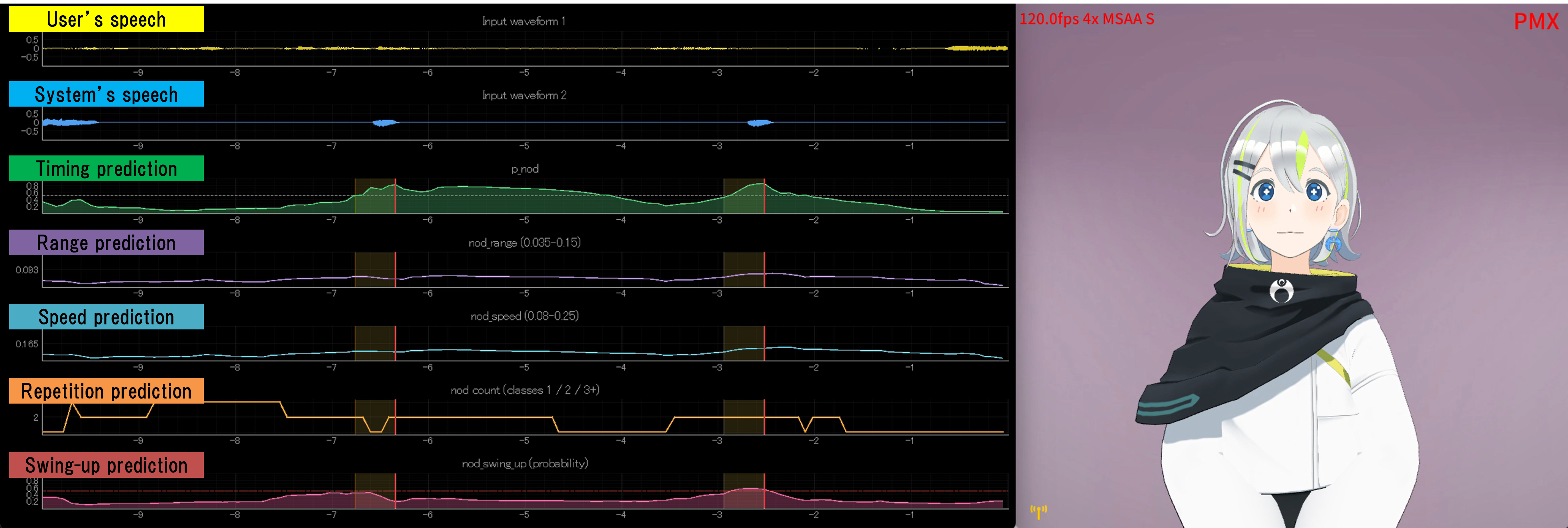
A nod is tiny until you try to animate one. Kazushi Kato and colleagues propose a real-time listener model that predicts nod timing together with motion range, speed, repetitions and direction. They integrated it into an avatar dialogue system and generated 45 videos from nine held-out Japanese dialogue sessions across five nodding conditions. Ninety crowd workers were recruited; 60 remained after an attention check. Those participants rated human likeness, naturalness, diversity, attentiveness, facilitation, understanding and empathy. Conditions using predicted timing and varied nod forms generally scored highest, while predicted kinematics did not significantly beat stochastic varied kinematics.
Small motion choices carry conversational meaning
The work separates two design questions that are often collapsed. Timing determines whether a response lands with the speaker’s turn; shape determines whether repeated feedback looks mechanical. A production team can use that distinction even without adopting this model. Review where a nod begins, how large it is, whether identical movements recur, and whether verbal and visual backchannels compete. The useful unit is the exchange, not an isolated animation clip.
The nonsignificant difference between learned and stochastic varied motion is also informative. More prediction is not automatically more perceptible value. If a simpler method performs similarly in a defined comparison, teams should weigh computation, control and failure behavior rather than treating model complexity as the product goal.
Ratings are impressions, not mind reading
Participants judged recorded videos, not their own live conversations, and a third of recruited workers failed the attention check. Higher ratings of apparent understanding or empathy mean the motion looked that way in this task; they do not show that the system understood the speaker or felt empathy. Language, animation style and dialogue setting may also affect timing norms. The paper supports a bounded claim about perceived listener behavior and a system capable of real-time operation.
Sources & limits
System and viewer-study evidence from recorded Japanese dialogue videos; ratings concern perceived avatar behavior and do not establish actual understanding or empathy.
- Real-time Generation of Listener Nodding via Prediction of Kinematic Parameters for Avatar Dialogue Systems
original-research · 14 July 2026 · Retrieved 15 September 2026
Send a correction with the passage and supporting source.