The proposed route to a signer
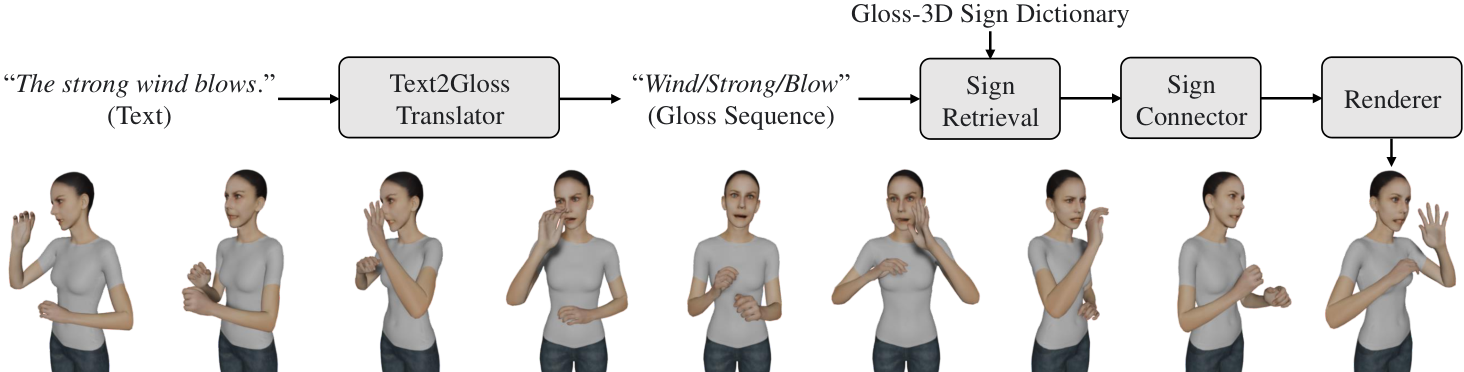
Ronglai Zuo and colleagues describe Spoken2Sign, a research method that connects spoken-language text to an animated signing avatar. Its stages include text-to-gloss translation, retrieval from a three-dimensional sign dictionary, transitions between signs, and rendering. The work evaluates technical translation and generation tasks, including on the German Sign Language PHOENIX-2014T benchmark. It does not establish that the resulting avatar can replace an interpreter in an everyday conversation.
Look between the boxes
Follow the arrows in the diagram. A sentence has to be interpreted, a sequence chosen, movements joined and a body displayed. Each step is a place where the result can go wrong. Better skin or a nicer outfit won't repair a translation mistake. A smooth transition can still lose the timing that makes a signed sentence intelligible. The character is what you see at the end; the decisions before it gets there deserve just as much attention.
Glosses are labels used to represent signs in a research pipeline; they are not a complete account of a signed language. For an editor covering a new system, the practical questions therefore concern both language and animation. Which language is supported? What material supplied the examples? Who judged the output, and could they understand it without reading the intended sentence first? The answers matter more than an impressive loop of a familiar phrase.
A demonstration worth reading closely
An avatar can make generated movement visible and repeatable, which is valuable for examining a proposed method. That makes it a research instrument as well as a potential interface. Publishing the intermediate stages helps readers locate the contribution and its limits. A future product would still need evaluation with fluent signers in the situations it intends to serve, including ways to notice and recover from errors. Here, the interesting advance is the proposed connection between translation and a controllable body; practical accessibility remains a separate question requiring its own evidence.
Sources & limits
Technical research and benchmark evaluation; no claim of interpreter equivalence, universal language coverage or demonstrated everyday accessibility.
- A Simple Baseline for Spoken Language to Sign Language Translation with 3D Avatars
original-research · 9 January 2024 · Retrieved 15 September 2026
Send a correction with the passage and supporting source.